

Operator Note: Do I Really Need a Contract?
You're already contracting. So be smart about it.
A lot of independent consultants and freelancers ask if they need a contract. There is a surprising amount of resistance among some solos to the idea of a contract. To many, a contract is something to be feared.
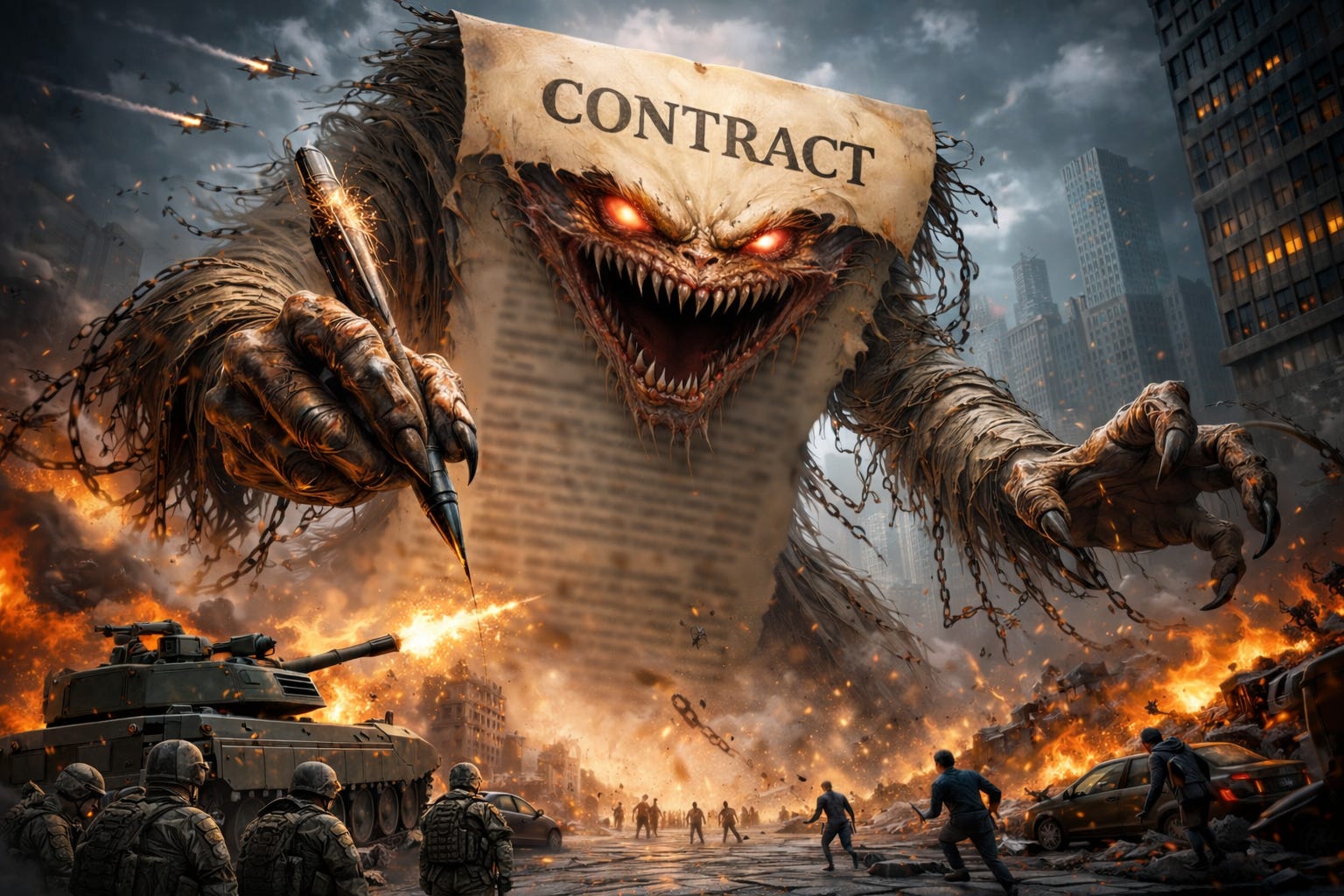
(Actual photo of a contract wreaking havoc on a once-thriving business ecosystem as John Cena, playing Sgt. Hardman Dukefist, prepares an attack plan. Photo source: 2016 Associated Press coverage of the Battle of the Forms.)
Sometimes they prefer the agility of not having to have something signed. Sometimes they’re afraid of the other side’s legalese – or they’re afraid that the other side may be turned off by their own boundaries.
Contracts, to some laypeople, signal complexity and an adversarial relationship. A risk to be feared.
In business, however, they’re inevitable.
Let’s talk about the right way to navigate this inevitability. Without confusion. Without resentment. Without unnecessary escalation. Without alienating a good client.
But first, let’s get this out of the way:
What Is a Contract?
I’m going to teach you what I spent a LOT of money to learn in law school: what a contract is.
Let’s set aside the “well, actually” nuances. There are three – only three – elements to a contract at common law:
1) Offer
2) Acceptance
3) Mutual consideration
That’s it.
(Technically, there are five elements if you count capacity and legality, but let’s assume you’re not trying to hire a drunk five-year-old to steal a car.)
For enforceability, some contracts require a bit more than that as a matter of state/jurisdictional statute. (A well-known example is a contract involving real estate rights, which generally requires a signed writing.) But generally speaking, the three elements above are all you need.
There are a LOT of finer points – many involving edge cases – regarding what can constitute an “offer” and an “acceptance,” but for the most part that bit is pretty self-explanatory. Somebody offers terms. The other side accepts terms. That’s the gist.
Consideration is what is exchanged – whether goods, services, rights, forbearances, anything. “I’ll give you or do X in exchange for you giving me or doing Y.”
And for it to be a contract, the consideration must be mutual. “I’ll give you X” without “you giving me Y” isn’t a contract; it is, at best, a gift.
Money can be consideration.
Writing and delivering a blog post can be consideration.
Fractional CFO services can be consideration.
Agreeing to not work for a competitor can be consideration (where not prohibited by law).
Anything you do or do not do (or promise to do or not do) can be consideration (to the extent legally allowed).
A contract, in and of itself, is nothing particularly scary. If you’ve ever bought or sold goods, services, or anything else legal, you have had a contract. More to the point, if you’ve ever had a client engagement, you have had a contract.

(An actual contract entering into effect. Photo source: That coupon flyer I get in the mail each week.)
The issue isn’t “Do I need a contract to do business?” That’s like asking “Do I need to breathe to live to 100?” (Answer: Yeah. It’s kinda the whole thing.)
The better question is: what does my contract need to look like?
To answer that question, we need to understand what we’re trying to solve for.
When “Informal” Contracts Go Wrong
Some people fear that it takes a lawyer to contend with “formal” contracts. I would argue that it takes a lawyer to contend with the lack of a “formal” contract.
Let’s say a marketing manager emails some copy to a graphic designer, asking for a banner ad, to be delivered a week from Monday, for $400. Nothing else. The graphic designer emails back to say yes.
Boom. Contract. No PDFs. No signatures. No legalese. Doesn’t matter. The essentials are there.

(A contract showing up unexpectedly. Photo source: The Epstein Files, for all we know.)
But notice that the example suggests some familiarity between the marketing manager and the graphic designer. Chances are that the two have worked together before. This will inform how a court may interpret the agreement and the parties’ expectations.
For instance, if the graphic designer is used to getting paid net-30, and if on this engagement the graphic designer goes 100 days without getting paid after turning in the deliverable, it is possible that the law will have something to say about that based on prior course of dealing – because the written terms of the agreement (the email) are silent on this point.
(Note: A few jurisdictions require that freelancers must get paid within a certain period of time.)
But what if, in this situation, the graphic designer and marketing manager haven’t worked together that much? And the parties are in a jurisdiction that doesn’t have statutory freelancer protections for timely payment? And then an extended period of time goes by without payment?
If statutory law is silent on the issue, then faced with this situation (including the ambiguity in what little exists in terms of a written contract), a court may nonetheless consider what a reasonable payment period is. Obviously, some ongoing indefinite promise to pay “at some point in the future” must be fulfilled, and “sometime between net-90 and the heat death of the universe” won’t cut it.
But now it’s murkier. Wouldn’t a little certainty be nice?
Or let’s consider this: Our graphic designer gets right to work – but then a couple days later, the marketing manager emails the graphic designer “Never mind” and seeks to back out of the contract. The graphic designer hasn’t finished or delivered the banner ad yet, but has already expended significant effort. The graphic designer may have even set aside other projects and/or business-development efforts to pursue completion of the banner ad.
What should the graphic designer do? Complete the project anyway and then demand full payment? Or stop all work and request partial payment? If the latter, how much? And does it make a difference whether the graphic designer is almost done or isn’t even 20% of the way there?
A court may find that the marketing manager’s company owes something to the graphic designer. But would the company owe the entire thing? It’s probably not right for the graphic designer to walk away with nothing, but it’s also may not be right to hold the company up for the entire amount. What’s fair? What’s reasonable? What’s equitable?
Or let’s say that the company doesn’t back out of the contract, the graphic designer submits the banner ad, and then the marketing manager requests some revisions. And the graphic designer delivers a new version.
And then the marketing manager requests additional revisions.
And then other stakeholders chime in with other notes. People the graphic designer has never even heard of are flooding her inbox – sometimes with contradictory requests. The vicious cycle continues, she’s not entirely sure whom to listen to, and weeks – maybe months – pass on what was supposed to be a simple banner ad.
Again, a court will have something to say, in the absence of contractual language, about when enough is enough (as well as whom the graphic designer is obligated to take direction from), but this situation, too, presents uncertainty.
I could present several more examples to make the same point – but there’s an even better point worth making:
It takes time, money, and effort to sue someone.
In the instant case, we’re talking about $400. Maybe a lot to the graphic designer, maybe not – but in the grand scheme of things, a piddling amount. Yes, small claims court is designed to be more streamlined than “regular” court, but wouldn’t it be better if this could be handled outside of the courthouse?
Which is to say, again: Wouldn’t it be nice if there was certainty here?
Issues with late-paying clients aside, not every problem or disagreement with a client means that the client is actively intending to screw the contractor. Sometimes, it’s just a bunch of people with different goals, experiences, and operational styles trying to do their best.
If you’re feeling uncharitable, Hanlon’s Razor is instructive here:
“Never attribute to malice that which is adequately explained by stupidity.”
Contracts Solve for “What If”
“Ignorance” or “ambiguity” may be more apt than “stupidity” here, so let’s consider accordingly.
In IT, there is a concept known as a BC/DR (Business Continuity/Disaster Recovery) plan. In a reductive nutshell: A BC/DR plan is an “oh shit, now what?” document intended to guide IT practitioners and their organizations when a disaster or other business interruption happens.
Your contract is a BC/DR plan too.
Anytime something unexpected happens, your contract acts as a guide; a well-constructed contract becomes the single source of truth as to what to do next.
Here is a list of some real-life scenarios – almost all of which have happened to me in one of my businesses – along with some of the questions those scenarios raise.
The client has additional requests during the course of a project. Are they timely? In scope? Too excessive? Or completely par for the course? Do they cost extra money? Are the requests clear enough? How do those requests impact deadlines, if at all? What are the contractor’s obligations upon receiving the requests?
What if the requests come from someone the contractor doesn’t normally deal with? Is the contractor permitted, compelled, or forbidden to act on those requests? Does the contractor have any notification obligations to other contacts? Who is an “authorized contact” and who isn’t? And if there are designated authorized contacts, how does the client change who they are?
What if the requests come in “urgently”? In what timeframe is the contractor obligated to respond or act (assuming the contractor is)? What if the requests come in during “off-hours”? At 7pm? At 1am? On a weekend? On Presidents Day? On New Year’s Day? Do off-hour availability and response impact money owed?
What if the client becomes uncommunicative – to the point of frustrating performance of the contract? What are the contractor’s options? How, if at all, does this impact deadlines? Or, for that matter, the length of the contract term?
May – or must – the contractor “do their best” on their own despite missing critical resources/materials/input/what-have-you from the client? If so, what are the contractor’s risks and liabilities?
Is the contractor forbidden from acting until the client delivers the necessary cooperation? If so, what resolves the situation?
Does the contractor have the right to declare the contract item in question (or the contract itself) successfully complete? Terminated early? Voided? How does this impact payment, intellectual property, and other rights and liabilities?
What if the client wants changes made to the deliverable? Does the client have that right? How many times? And to what extent? How long does the client have after delivery to request changes? How do we know if those changes are in scope? What if the requested changes contradict what the client originally asked for? What’s the difference between revisions and the client finagling a “two-for-the-price-of-one” deal out of the contractor?
Payment was supposed to happen by X date. It didn’t. What now? And how late is the payment? If the performance of the contract is still ongoing, does late payment impact performance and/or deadlines? Is there a penalty for late payment of some kind? If so, is that penalty automatically applied, or must the contractor re-invoice? Does late payment impact any intellectual property rights being granted to the contractor?
(Oh, and by the way, must the client initiate/send payment by the payment due date? Or must payment be actually received by the contractor by the payment due date?)
What if the client is a huge conglomerate with hundreds of subsidiaries, parent companies, and/or related entities? Which company is the actual billable client obligated under the contract? Is that subject to change? By whom? Under what circumstances? Is consent by the other party necessary?
(These are just a few of the most common what-if situations.)
A well-constructed contract, as a list of standard operating procedures, empowers you to quickly and effectively solve for situations like these – clearly laying out who can or must do what when and how. If one of these scenarios crops up, you’ll be able to turn to the contract and – non-confrontationally, non-adversarially – educate the client on what happens next and what the options are.

(Contracts can be perfectly proper and polite. Photo source: Your Mom.)
The goal here is not “Hey, now I’m coming after you with some punishment.”
The goal, usually, is “So it looks like we’re in Situation XYZ, which means this gets handled by ABC. So we could do this, or we could do that. Or we could handle it this third way. What would you like to do?”
And yes, when a client truly decides to become irreversibly adversarial, you also get protection in the form of a “Hey, this goes against our agreement, remember?”
What this all spells is increased certainty – both legal certainty and practical certainty. Companies like (or, at least, respond better to) certainty. With a clearly spelled out written agreement, you are far less likely to face a client with an antagonistic position of “Well, here’s what I think we’ve agreed to.”
When an agreement is perfectly clear and thorough, a client cannot maintain an antagonistic position without effectively saying “I know what we agreed to, and I don’t care; I’m reneging.” (And, but for the most toxic, few business clients ever want to do that.)
That means that the clearer and more thorough your contracts are, the better you empower yourself to effectively solve for client management issues as they come up. Without threats. Without legal escalation. Just with black-and-white guidance tempered by business judgment and mutual problem solving.
Contracts are a fact of business. Well-written contracts reduce risk.
(Disclaimer: I am an internet bozo. This article/letter is simplified, non-exhaustive, and is provided for informational, educational, and/or entertainment purposes only. Neither this nor other B2BS content constitute legal advice or the creation, implication, or confirmation of an attorney-client relationship. For actual legal advice, personally consult with an attorney authorized to practice in your jurisdiction.)
Nice post for the layman on contracts. As I tell people, nothing is potentially more expensive or more aggravating than NOT having a solid contract in hand BEFORE doing any work.